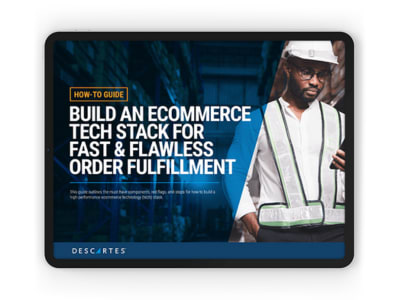
eBook: Build an Ecommerce Tech Stack for Fast & Flawless Order Fulfillment
This ebook teach ecommerce business leaders about different types of software solutions and how to choose the right combination to solve your unique business problems. It answers questions such as: - What is a tech stack? - Do I need a tech stack? - Why integrated technology? - Which programs do I need? - What types of solutions does Descartes offer?
CHAPTERS
BUILD AN ECOMMERCE TECH STACK FOR FAST & FLAWLESS ORDER FULFILLMENT
HOW-TO GUIDE
This guide outlines the must-have components, red flags, and steps for how to build a high-performance ecommerce technology (tech) stack.
https://twitter.com/DescartesSG https://www.facebook.com/DescartesSystemsGroup https://www.linkedin.com/company/descartes-systems-group http://www.descartes.com
CHAPTERS
What’s a Tech Stack?
What’s a Tech Stack? Everyone wants fast and flawless ecommerce order fulfillment, but sometimes it seems impossible. You know technology can help, but with countless software options available, it’s hard to know where to start. Descartes has been in the logistics technology business for a long time, and we’re here to lift the burden. Let’s talk about tech stacks for ecommerce.
A technology stack sounds more complex than it is. A tech stack, as ecommerce business leaders commonly define it, is simply a collection of software programs that all talk to each other and work together to accomplish a specific process. This is also called an app stack, especially by IT people, but, to avoid overcomplication, we call it a tech stack in this guide.
Whether you fulfill 50 orders per day or 50,000, a tech stack allows you to use integrated technology for things you used to do by hand, such as typing customer information into a label- printing program. A good tech stack will equip you with tools to increase efficiency, prevent errors, and make sure your customer gets the right order on time, every time. Tech stacks are not one- size-fits-all but can differ based on business type and growth stage.
Think of a tech stack as a set of connected building blocks. You start at the ground and add each block of technology as your business grows. They all need to be sturdy and work together.
https://twitter.com/DescartesSG https://www.facebook.com/DescartesSystemsGroup https://www.linkedin.com/company/descartes-systems-group http://www.descartes.com
CHAPTERS
Do I Need a Tech Stack?
It’s Time For a Tech Stack When You Have: Unhappy Customers and Bad Reviews The most common problem is negative feedback from your customers, i.e., complaints about late orders, receiving the wrong items, and canceling orders due to inventory availability. In short, your customers will tell you where they need better performance from your business, so pay close attention to feedback both online and through your customer service team.
Staffing Shortages and Overtime The second most common way to know you need integrated technology is to look at the overtime costs and if you are thinking of hiring new or temporary employees. Sometimes adding more people is a quick fix, but it can soon lead to inefficiencies and more fulfillment errors.
Too Many Tedious, Error-Prone, Repetitive Tasks A third way to tell it’s time for a tech stack is when your workers frequently become bottlenecked by too many time-consuming manual tasks that should be automated. If manual data entry, handwritten records, double data entry, or manual configuration of settings/preferences is slowing you down, it’s time for a tech stack.
Without a foundation of scalable integrated technology, these problems will worsen as your business continues to grow.
https://twitter.com/DescartesSG https://www.facebook.com/DescartesSystemsGroup https://www.linkedin.com/company/descartes-systems-group http://www.descartes.com
CHAPTERS
Why Integrated Technology?
The Value of Integrated Technology As your business starts to scale, you will outgrow certain processes and stand-alone technologies that used to work when it was smaller.
Why use integrated technology for ecommerce? y It makes businesses operate faster by preventing double data entry
y It improves accuracy and prevents keyed entry errors
y It provides greater visibility on holistic performance with cross-platform data
y It equips businesses to scale up and down as needed for growth and peak seasons
y It reduces the number of people needed to run fulfillment operations
y It saves businesses money
How can an integrated tech stack save my business money? Businesses that invest in a tech stack often see a significant return on investment from:
y Savings in labor costs
y Savings in shipping costs
y Reduced shrink
y Increased fulfillment process efficiency
y Repeat business/evangelism from happy customers
y Decreased fulfillment errors
https://twitter.com/DescartesSG https://www.facebook.com/DescartesSystemsGroup https://www.linkedin.com/company/descartes-systems-group http://www.descartes.com
CHAPTERS
Before we get too deep into software solutions details, let’s identify a basic tech journey for your business. While every business’ tech journey will be unique, everyone benefits from a high-level overview of how things fit together before getting started.
The tech stack journey for ecommerce fulfillment takes two very basic forms: direct-to-consumer (D2C) and business-to-business (B2B). As you begin to brainstorm the best tech journey for your business, these simplified examples will provide a basic idea of where to start.
Your Tech Journey
Your Tech Journey
Questions to consider when planning your tech journey:
https://twitter.com/DescartesSG https://www.facebook.com/DescartesSystemsGroup https://www.linkedin.com/company/descartes-systems-group http://www.descartes.com
CHAPTERS
Four Must-Have Capabilities
Four Must-Have Capabilities of a Tech Stack What belongs in an ecommerce tech stack? Think of an ecommerce tech stack like a set of connected building blocks. You start at the ground when your business is small, and you add each block of technology to the stack as your business grows. Each block needs to be sturdy enough to support the weight of the next one, and it must be constructed to fit with the others in a secure way so the stack doesn’t topple. Depending on which stage your business is in right now, you may only need the first couple of blocks. However, you should choose them with the future stack in mind.
These programs work together to create a smooth experience every step of the way. For each program, we will cover important considerations for that type of software, the red flags to avoid when building your tech stack, and how to know when your business is ready to add that type of software. Again, you may not need all these capabilities yet, but understanding the programs will help you lay a solid foundation for future growth.
A mature ecommerce tech stack includes four capabilities for fulfillment: ecommerce platform, shipping, inventory/ order management, and warehouse management.
https://twitter.com/DescartesSG https://www.facebook.com/DescartesSystemsGroup https://www.linkedin.com/company/descartes-systems-group http://www.descartes.com
CHAPTERS
1. Ecommerce Platform
The first block of your tech stack is an ecommerce platform. This is the software that allows your customers to shop from YOUR website rather than a marketplace such as Amazon or Etsy. As the foundation of your tech stack, it needs to support all the other programs you will eventually add. You can use a pre-built version or build your own.
You are ready for an ecommerce platform when: y You want to run a fully functioning online store where people can purchase your products. y You want secure payment processing for your customers. y You want to manage sales, marketing, and your website all in one place. y You want full control over your brand with a concrete online presence.
Considerations for choosing an ecommerce platform: y Ease of use. It doesn’t have to be overly fancy, but it DOES need to be user-friendly. y Integrations/applications/plugins to help you grow your business (i.e., marketing, website development, CRM) y Scalability. Do you anticipate a high online sales volume? Make sure your platform can handle it. y Need to handle both in-person (POS) and online sales? Not all platforms do this, so check for this capability.
Red flags when choosing an ecommerce platform: y Limited customization for your brand’s look, feel, and experience y Limited or small number of integrations y Poor reputation for cyber/data security y No online identity verification (i.e., single sign on, two-factor authentication)
1 Ecommerce Platform
https://twitter.com/DescartesSG https://www.facebook.com/DescartesSystemsGroup https://www.linkedin.com/company/descartes-systems-group http://www.descartes.com
CHAPTERS
2. Shipping Solution
2 Shipping Solution The second building block of your ecommerce tech stack is shipping software. Not only will this save you time versus manually entering order information into carrier shipping websites (and all the typos!), but it will also allow you to rate-shop multiple carriers (i.e., FedEx, USPS, and UPS) to find the best shipping rates. Most shipping software companies negotiate discounted shipping rates with carriers and pass the savings along to their customers, so you will pay less for shipping through a software company than you would by using a carrier directly.
You are ready for shipping solution when: y You want cheaper shipping. y Typing shipping information into a carrier’s website for every order is causing a HUGE bottleneck. y Keyed entry errors are causing shipping problems and unhappy customers. y You want to use more than one carrier and start shipping rate comparisons.
Considerations for choosing a shipping solution: y Carrier rate shopping. Easily compare and choose the best price for a given shipping timeframe. y Automations. Time-consuming, repetitive tasks can be automated to save time during shipping. y Live customer support. Have a support team of real people to help keep things running smoothly. y Integrations with all your preferred carriers, including support for all carrier-specific services.
Red flags when choosing a shipping solution: y Limited number of integrations with all your sales channels and marketplaces. y Automatic billing when you ship above your pricing tier. Some programs charge immediately. y Limited scalability. Will your shipping software keep up during peak season or a surge in orders? y Unstable company. Choose a company with a long-standing reputation of excellent service.
https://twitter.com/DescartesSG https://www.facebook.com/DescartesSystemsGroup https://www.linkedin.com/company/descartes-systems-group http://www.descartes.com
CHAPTERS
3. Inventory/Order Mgmt.
The third must-have capability of an ecommerce tech stack is an inventory/order management system. In short, this helps you know what’s in stock, prevents overselling, and organizes complex multi-channel orders. There are three types of software that accomplish this: an inventory management system (IMS), an order management system (OMS), and an enterprise resource planning (ERP) program.
What’s the difference between an IMS, OMS, and ERP? IMS and OMS titles for software are often used interchangeably, with only slight differences between the two types of programs. Generally, an IMS is considered a more “lightweight” and less expensive program, while an OMS provides slightly more complex features and functionality to solve the same basic set of problems. If you compare the descriptions and offerings of different IMS and OMS programs, you will find the differences to be inconsistent and minor.
An ERP, on the other hand, is usually a much more robust software program than an IMS or OMS. It offers the inventory and order management capabilities of an IMS or OMS, plus advanced day-to-day business management tools. From procurement to processes, financials to human resources, an ERP delivers advanced software capabilities to manage highly complex business functions in one platform. While an IMS or OMS may be enough for a direct-to-consumer company, wholesale sellers and manufacturers need an ERP.
IMS and OMS are often used interchangeably, while ERP performs the tasks of an IMS/OMS plus additional functionality. When comparing these programs, focus on features and capabilities rather than software names.
Based on the tech stack journey you have in mind, you may already have an idea which of these solutions could be the best fit for your business. If not, let’s explore each one in greater detail. Ultimately, it’s not the name of the software that matters; it’s finding the feature set that best solves your ecommerce fulfillment problems.
3 Inventory/Order Management
https://twitter.com/DescartesSG https://www.facebook.com/DescartesSystemsGroup https://www.linkedin.com/company/descartes-systems-group http://www.descartes.com
CHAPTERS
3a. IMS
An inventory management system (IMS) maintains a common inventory record that reflects how much of each item you have in stock in real-time. It connects to all your shops/marketplaces, updating the inventory as soon as you sell an item so that it’s de-listed on all channels. This will prevent you from overselling your inventory and getting blocked from selling on a particular channel. It will also help you maintain healthy quantities of stock and aid in strategic planning.
You are ready for an inventory management system when: y You start overselling your inventory. y You start selling on multiple channels. y You lose sight of what you physically have on hand. y You have no idea what’s in stock and what isn’t at any given moment.
Considerations for choosing an inventory management system: y Must integrate with ALL your sales channels, including POS (if used), to account for every sale. y Automation based on minimum and maximum on-hand stock that automatically reorders when low. y Forecasting and planning. Leverage the data collected to generate reports that aid in strategy. y Cloud-based (SaaS). A power outage could wipe out records if you rely solely on a desktop application.
Red flags when choosing an inventory management system: y Frequent bugs or system crashes. Read online reviews to gauge the reliability of an IMS. y Inadequate data security. You need to protect your customers’ personal information from hackers. y No cycle counting feature. You still need to physically count your inventory to keep records. y Limited scalability. It needs to grow with your business as you add more sales channels/SKUs.
3a Inventory Management System
https://twitter.com/DescartesSG https://www.facebook.com/DescartesSystemsGroup https://www.linkedin.com/company/descartes-systems-group http://www.descartes.com
CHAPTERS
3b. OMS
Like an IMS, an order management system (OMS) provides a transparent view into the state of inventory. It also connects all your sales channels, including point-of-sale (POS), wholesale (B2B), and ecommerce retail (D2C), to manage the lifecycle of every order. From order entry to inventory management, fulfillment to after-sales service, this program keeps every order’s information organized, and it allows customers to check when an order will arrive.
You are ready for an order management system when: y Your multichannel business grows in complexity beyond what your IMS can handle. y Your orders travel to multiple facilities for assembly, processing, packaging, or distribution. y Your customers need a seamless omnichannel experience with your brand. y You want customers to be able to check when an order will arrive.
Considerations for choosing an order management system: y Must integrate with ALL your sales channels, including POS (if used), to collect information from every sale. y Real-time inventory. To avoid overselling and stockouts, make sure your program delivers real-time inventory. y Visibility on the entire supply chain as well as the ability to isolate events. This aids in troubleshooting. y Customizable order management processes. Configure rules and processes to suit your business needs/goals.
Red flags when choosing an order management system: y No delivery and service scheduling ability. You need to be able to match commitments to available inventory. y Weak/underdeveloped customer engagement technologies. Make sure it’s easy to involve the customer. y Limited or clunky data analytics/reporting. Choose high-quality reporting to aid strategic planning/operations. y Poor distributed order management. You need the program to route orders to the correct destinations.
3b Order Management System
https://twitter.com/DescartesSG https://www.facebook.com/DescartesSystemsGroup https://www.linkedin.com/company/descartes-systems-group http://www.descartes.com
CHAPTERS
3c. ERP
Another type of inventory/order management system (and much more) is an ERP program, such as NetSuite. This software helps you run your whole business, pulling all your supply chain, inventory, accounting, project management, and procurement information together in one place. If your business is already a B2B (wholesale seller), you may need this software right away. For D2C businesses, depending on the size, you may start out using capabilities provided by your ecommerce platform, then grow into an ERP as you add channels.
You are ready for an ERP when: y You need integrated functionality beyond inventory and order management. y You sell products B2B (wholesale) and/or use limited truck load (LTL) shipping. y Your business operations reach a level of complexity that the rest of your tech stack can’t easily manage. y You start managing projects, people, procurement, and complex processes.
Considerations for choosing an ERP: y Integrations. Is it able to easily integrate with the other programs in your tech stack? y User interface. Is the information laid out in a way that makes sense to you and is easy to navigate? y Implementation. How much does it cost, how long does it take, and do you have the resources? y Data security. This program will house your customer and financial information, so security is crucial.
Red flags when choosing an ERP: y Difficult data migration. It must easily incorporate your existing data and let data flow freely. y Costly customization. How much will you pay to get the program to work how you need it to? y No live customer support. This program is the brains of your business, so ensure expert support. y Complicated program that requires a lot of training. Make sure your team can easily use this.
3c Enterprise Resource Planning
https://twitter.com/DescartesSG https://www.facebook.com/DescartesSystemsGroup https://www.linkedin.com/company/descartes-systems-group http://www.descartes.com
CHAPTERS
4. Warehouse Management
The fourth must-have capability for your tech stack is a WMS with mobile barcode scanning. This program helps you manage complex warehouse operations, equipping you to effectively manage large quantities of SKUs in multiple warehouses. You will know where every item in your inventory is located, and you can use multi-picking strategies to reduce walking time. Barcode scanning eliminates data entry errors and keeps your inventory up to date. The result? Faster, more accurate order fulfillment.
You are ready for a warehouse management system when you: y Fulfill at least 50 orders per day y Struggle with picking errors and picking speed y Experience customer complaints about receiving the wrong items y Receive customer complaints about orders being delivered late
Considerations for choosing a warehouse management system: y Mobile-based. Ensure the WMS has a mobile app and will not tie your workers to a scanning station. y Scalability. Not all WMS solutions can scale to enterprise volumes. Can it handle the volume you hope to reach? y Live customer support. Be sure you can get help from real people at the moment you need it. y User-friendly interface. Warehouse workers need a program that’s quick to learn and easy to use.
Red flags when choosing a warehouse management system: y Cannot handle high volumes. Not all solutions perform as well as they claim. Read reviews and case studies. y Cluttered user interface with many complex features. Most warehouse workers will only use a handful of features. y Cannot integrate with your shipping program. Your WMS and shipping must work together seamlessly. y Complex, costly, and lengthy implementation process. How much time, money, and expertise does this require?
4 Warehouse Management System
https://twitter.com/DescartesSG https://www.facebook.com/DescartesSystemsGroup https://www.linkedin.com/company/descartes-systems-group http://www.descartes.com
CHAPTERS
Choose Your Tech Stack
Choose Your Technology Stack The tech stack journey for ecommerce fulfillment takes two very basic forms: direct-to-consumer (D2C) and business-to-business (B2B). As you begin to brainstorm the best tech journey for your business, these simplified examples will provide a basic idea of where to start.
Which path looks the most like your business today? Depending on your business type, go-to-market strategy, and order volume, you may not need every part of the four must-have capabilities yet.
Choose a technology app stack that best suits your current business needs. You can always add more pieces as your business grows in complexity.
https://twitter.com/DescartesSG https://www.facebook.com/DescartesSystemsGroup https://www.linkedin.com/company/descartes-systems-group http://www.descartes.com
CHAPTERS
Our Solutions
Build a Tech Stack with Descartes Because we know that strong integrations and strong partnerships build strong businesses, Descartes has curated a selection of software programs to help our customers build a high-performance ecommerce tech stack. Ready to speak with an expert about how everything fits together?
https://twitter.com/DescartesSG https://www.facebook.com/DescartesSystemsGroup https://www.linkedin.com/company/descartes-systems-group http://www.descartes.com https://www.descartes.com/lp/building-ecommerce-tech-stack-fast-flawless-fulfillment
CHAPTERS
How to Get Started
How to Get Started Building an ecommerce tech stack is well worth the time, money, and effort. Not only will technology relieve the burden of your current fulfillment problems, but it will also position your company for sustainable growth.
The ecomm team at Descartes is ready to help you take the next step. To get started with building your tech stack, speak with an ecommerce expert at Descartes. We will ask you questions about your business, the technology you already use, your most urgent business problems, and your goals for growth.
Then, we will advise you on getting started with the best integrated software solutions for your business.
https://twitter.com/DescartesSG https://www.facebook.com/DescartesSystemsGroup https://www.linkedin.com/company/descartes-systems-group http://www.descartes.com https://www.descartes.com/lp/building-ecommerce-tech-stack-fast-flawless-fulfillment
CHAPTERS
About Descartes
Descartes (Nasdaq:DSGX) (TSX:DSG) is the global leader in providing on- demand, software-as-a-service solutions focused on improving the productivity, performance and security of logistics-intensive businesses. Customers use our modular, software-as-a-service solutions to route, schedule, track and measure delivery resources; plan, allocate and execute shipments; rate, audit and pay transportation invoices; access global trade data; file customs and security documents for imports and exports; and complete numerous other logistics processes by participating in the world’s largest, collaborative multimodal logistics community. Our headquarters are in Waterloo, Ontario, Canada and we have offices and partners around the world.
Learn more at www.descartes.com, and connect with us on LinkedIn and Twitter.
The Descartes Systems Group Inc. 120 Randall Drive, Waterloo, Ontario, N2V 1C6, Canada Toll Free 800.419.8495 | Int‘l 519.746.8110 www.descartes.com | info@descartes.com
Uniting the People & Technology That Move the World © The Descartes Systems Group Inc. All rights reserved.
About Descartes Systems Group
http://www.descartes.com https://www.linkedin.com/company/descartes-systems-group https://twitter.com/DescartesSG http://www.descartes.com mailto:info%40descartes.com?subject= https://twitter.com/DescartesSG https://www.facebook.com/DescartesSystemsGroup https://www.linkedin.com/company/descartes-systems-group http://www.descartes.com
It’s Time For a Tech Integrated Technology Your Tech Journey Four Must-Have Capabilities of a Tech Stack Ecommerce Platform Shipping Solution Inventory/Order Management Inventory Management System Order Management System Enterprise Resource Planning Warehouse Management System Choose Your Technology Stack Build a Tech Stack with Descartes How to Get Started About Descartes Systems Group What's a Tech Stack It's Time For a Tech Stack
Button 1081: Page 1:
Button 1093: Page 1:
Button 1094: Page 1:
Button 1095: Page 1:
Button 431: Page 1:
Button 433: Page 1:
Button 434: Page 1:
Button 435: Page 1:
Button 436: Page 1:
Button 437: Page 1:
Button 438: Page 1:
Button 439: Page 1:
Button 440: Page 1:
Button 441: Page 1:
Button 442: Page 1:
Button 443: Page 1:
Button 444: Page 1:
Button 445: Page 1:
Button 446: Page 1:
Button 447: Page 1:
Button 448: Page 1:
Button 1087: Page 2: Page 3: Page 4: Page 5: Page 6: Page 7: Page 8: Page 9: Page 10: Page 11: Page 12: Page 13: Page 14: Page 15: Page 16: Page 17:
Button 1097: Page 2: Page 3: Page 4: Page 5: Page 6: Page 7: Page 8: Page 9: Page 10: Page 11: Page 12: Page 13: Page 14: Page 15: Page 16: Page 17:
Button 1099: Page 2: Page 3: Page 4: Page 5: Page 6: Page 7: Page 8: Page 9: Page 10: Page 11: Page 12: Page 13: Page 14: Page 15: Page 16: Page 17:
Button 10100: Page 2: Page 3: Page 4: Page 5: Page 6: Page 7: Page 8: Page 9: Page 10: Page 11: Page 12: Page 13: Page 14: Page 15: Page 16: Page 17:
Button 320: Page 2: Page 3: Page 4: Page 5: Page 6: Page 7: Page 8: Page 9: Page 10: Page 11: Page 12: Page 13: Page 14: Page 15: Page 16:
Button 321: Page 2: Page 3: Page 4: Page 5: Page 6: Page 7: Page 8: Page 9: Page 10: Page 11: Page 12: Page 13: Page 14: Page 15: Page 16: Page 17:
Button 369: Page 2: Page 3: Page 4: Page 6: Page 7: Page 8: Page 9: Page 10: Page 11: Page 12: Page 13: Page 14: Page 15: Page 16: Page 17:
Button 368: Page 2: Page 3: Page 5: Page 6: Page 7: Page 8: Page 9: Page 10: Page 11: Page 12: Page 13: Page 14: Page 15: Page 16: Page 17:
Button 367: Page 2: Page 4: Page 5: Page 6: Page 7: Page 8: Page 9: Page 10: Page 11: Page 12: Page 13: Page 14: Page 15: Page 16: Page 17:
Button 370: Page 2: Page 3: Page 4: Page 5: Page 7: Page 8: Page 9: Page 10: Page 11: Page 12: Page 13: Page 14: Page 15: Page 16: Page 17:
Button 371: Page 2: Page 3: Page 4: Page 5: Page 6: Page 8: Page 9: Page 10: Page 11: Page 12: Page 13: Page 14: Page 15: Page 16: Page 17:
Button 372: Page 2: Page 3: Page 4: Page 5: Page 6: Page 7: Page 9: Page 10: Page 11: Page 12: Page 13: Page 14: Page 15: Page 16: Page 17:
Button 373: Page 2: Page 3: Page 4: Page 5: Page 6: Page 7: Page 8: Page 10: Page 11: Page 12: Page 13: Page 14: Page 15: Page 16: Page 17:
Button 378: Page 2: Page 3: Page 4: Page 5: Page 6: Page 7: Page 8: Page 9: Page 10: Page 11: Page 12: Page 13: Page 15: Page 16: Page 17:
Button 374: Page 2: Page 3: Page 4: Page 5: Page 6: Page 7: Page 8: Page 9: Page 11: Page 12: Page 13: Page 14: Page 15: Page 16: Page 17:
Button 379: Page 2: Page 3: Page 4: Page 5: Page 6: Page 7: Page 8: Page 9: Page 10: Page 11: Page 12: Page 13: Page 14: Page 16: Page 17:
Button 375: Page 2: Page 3: Page 4: Page 5: Page 6: Page 7: Page 8: Page 9: Page 10: Page 12: Page 13: Page 14: Page 15: Page 16: Page 17:
Button 380: Page 2: Page 3: Page 4: Page 5: Page 6: Page 7: Page 8: Page 9: Page 10: Page 11: Page 12: Page 13: Page 14: Page 15: Page 17:
Button 376: Page 2: Page 3: Page 4: Page 5: Page 6: Page 7: Page 8: Page 9: Page 10: Page 11: Page 13: Page 14: Page 15: Page 16: Page 17:
Button 381: Page 2: Page 3: Page 4: Page 5: Page 6: Page 7: Page 8: Page 9: Page 10: Page 11: Page 12: Page 13: Page 14: Page 15: Page 16:
Button 377: Page 2: Page 3: Page 4: Page 5: Page 6: Page 7: Page 8: Page 9: Page 10: Page 11: Page 12: Page 14: Page 15: Page 16: Page 17:
Button 366: Page 3: Page 4: Page 5: Page 6: Page 7: Page 8: Page 9: Page 10: Page 11: Page 12: Page 13: Page 14: Page 15: Page 16: Page 17:
Button 423: Button 424: Button 425: Button 427: Button 426: Button 428: Button 429: Button 415: Button 419: Button 417: Button 421: Button 416: Button 420: Button 418: Button 422: Button 430: