Online Buying Grows, But Too Many Consumers Still Experiencing Delivery Woes
Despite year-over-year improvements by retailers and logistics providers, consumer dissatisfaction remains high. In North America and the U.K., ecommerce is expected to surpass brick-and-mortar purchases within a year. Retailers can gain a competitive edge and enhance loyalty by improving delivery reliability, security, and offering cost-effective options. Learn more in this survey of 8,000 consumers.
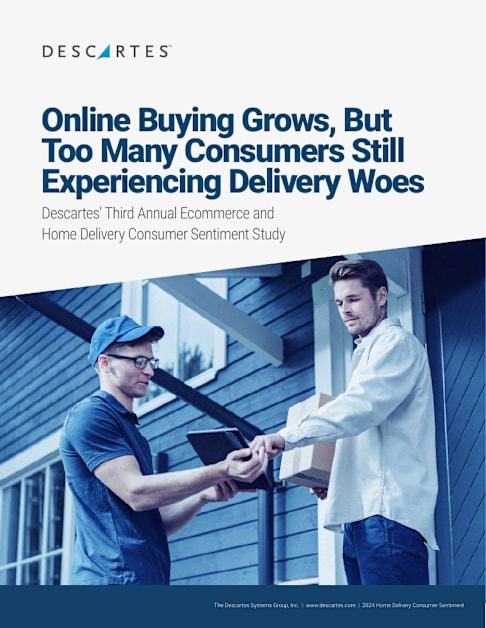
Online Buying Grows, But Too Many Consumers Still Experiencing Delivery Woes Descartes’ Third Annual Ecommerce and Home Delivery Consumer Sentiment Study
The Descartes Systems Group, Inc. | www.descartes.com | 2024 Home Delivery Consumer Sentiment
http://www.descartes.com
22The Descartes Systems Group, Inc. | www.descartes.com | 2024 Home Delivery Consumer Sentiment
Introduction
Does a mature ecommerce market offer the quality of delivery experience consumers expect and, if not, where do retailers and delivery organizations need to improve? How have economic challenges affected online purchasing and delivery sentiment? For the third year in a row, Descartes, in combination with SAPIO Research, surveyed 8,000 consumers in Europe and North America to gain a comprehensive view of the state of ecommerce and home delivery performance. The results of the study indicate incremental year-over-year improvement in home delivery performance by retailers and delivery companies (e.g., carriers, couriers and logistics services providers), but the level of consumer dissatisfaction remains high.
In some markets, notably North America and the U.K., ecommerce, as a percentage of purchases, is expected by consumers to exceed brick and mortar purchases in the next 12 months. Online consumers continue to become more sophisticated and knowledgeable. Their purchasing decisions and brand perceptions are influenced by home delivery performance and their expectations are increasingly nuanced, reflecting the ever-expanding range of purchases in diverse product categories. Perceptions around cost, speed and timeliness of delivery, as well as security expectations, vary not only across countries and demographics but also depend on the type and value of purchase.
By improving delivery reliability and security, and offering more cost-effective delivery options, retailers can gain competitive differentiation, improve customer loyalty and improve the profitability of their ecommerce channels.
Top Level Findings Below are high-level, at-a-glance takeaways from the research*
44% preferred lower-cost
deliveries while 28% preferred
faster deliveries
67% experienced a delivery problem
57% cited convenience as the top reason for increasing
purchases
63% took some form of action that
had negative consequences for
the retailer or delivery company
57% made purchases in
new categories in the past year
39% increased purchases versus
16% decreased purchases in the
prior year
66% favored delivery options that could
result in lower delivery costs to the
retailer or delivery company
http://www.descartes.com
33The Descartes Systems Group, Inc. | www.descartes.com | 2024 Home Delivery Consumer Sentiment
Ecommerce growth may be slower, but consumers are more committed
Consumer interest in ecommerce continues to grow, but no longer at the accelerated pace as during the pandemic (see Figure 1). Ecommerce does, however, continue to gain traction with consumers as the study shows that 44% intend to increase their online purchasing frequency to at least every two weeks, compared to 34% in 2023 and 32% in 2022.
Furthermore, consumers are now accustomed to buying online and expect to make even more purchases for home delivery in the next 12 months (see Figure 2). Consumers expect to make almost half (49.5%) of all purchases online within the next year—a 4.9% increase versus today (2024). Indeed, in some markets—notably the U.K. (59%) and North America (52%)—consumers expect to buy more often online than at a physical store within a 12-month period.
42% 39%
56% 17% 16%
8% 41% 36%
45%
Figure 1: Changes in online purchasing behavior
Which of the following statements best describes how your online purchasing behavior has changed in the last year?
Source: Descartes / SAPIO Research2022 Study 2023 Study 2024 Study
The number of online purchases I make has increased
The number of online purchases I make has decreased
The number of online purchases I make has stayed the same
Source: Descartes / SAPIO Research
49% 50%
48% 12 months from nowToday
44% 45%
46%
What percentage of all your purchases did you make online and have delivered to your home?
Figure 2: The percentage of purchases made online and delivered
2022 Study 2023 Study 2024 Study
http://www.descartes.com
44The Descartes Systems Group, Inc. | www.descartes.com | 2024 Home Delivery Consumer Sentiment
Consumers are enjoying the convenience (57%) of the online buying and delivery model and like the fact that the online ordering process has gotten easier (49%). Almost half (48%) also say they like home delivery because they don’t have to go out of their way to pick purchases up, further underlining the value of an effective, easy and convenient online shopping experience.
The value of this convenience is particularly strong for seniors over 65 (71%), where purchasing for convenience grew 6% year-over-year. By contrast, getting used to the convenience is cited by just 42% of those aged 18–24.
Across all demographics, consumers are also expanding the type of goods they purchase online, further demonstrating the growing confidence in ecommerce buying. According to the study, 57% made online purchases in at least one product category—for the first time—in the past year.
The effects of inflation and higher prices, however, are continuing to impact the pace of ecommerce growth. In 2024, “less disposable income” was again the top reason (42%) inhibiting online purchases, up from 37% in 2023 when, for the first time, it replaced “seeing the actual product before buying.” By contrast, less disposable income was the fifth highest choice in 2022, underscoring the impact on buying power that has occurred in the past two years.
It is, however, also true that delivery issues are cited as a barrier to purchasing in the future. When respondents were asked what would put them off making more online purchases in the future, one in five (21%) say they have had negative delivery experiences, 20% say deliveries are not reliable, 17% have been dissatisfied with the delivery process and 16% say deliveries are not environmentally friendly.
While retailers cannot address customers’ financial challenges, mediocre delivery performance and inconsistent delivery experiences are solvable problems. To avoid this barrier to purchasing, retailers and delivery organizations need to raise the quality and consistency of the home delivery experience.
http://www.descartes.com
55The Descartes Systems Group, Inc. | www.descartes.com | 2024 Home Delivery Consumer Sentiment
Understanding customer delivery personas is an opportunity for retailers
When it comes to consumer expectations for home delivery, not all think about delivery in the same way. Consumers have different delivery personas—and these can vary by the products being delivered. Delivery personas involve a combination of cost, delivery speed, precision, value-added services and information about delivery options (e.g., most environmentally friendly), which allow retailers to craft a number of delivery experiences that best fit their customers’ preferences.
This study reinforces findings from 2023 that fewer customers are prepared to pay for fast delivery, preferring instead a lower cost alternative. While the era of instant gratification may not be completely over, more than two fifths (44%) cite “lowest cost, speed is less important” as the top delivery preference in 2024, up from 39% in 2023 (see Figure 3). Furthermore, 20% say they want a “precise delivery window, with speed being less important.” Just 15% rate “fastest delivery, with timeliness being less important” and only 13% say “fast and precise, with cost being less important.”
Delivery personas allow retailers to craft a number of delivery experiences that best fit their customers’ preferences.
Source: Descartes / SAPIO Research
Most environmentally friendly, speed less important
Figure 3: Consumer delivery preferences What best describes your delivery preference?
Precise delivery window, speed less important
Fastest, timeliness
less important
Fast and precise, cost less important
22% 20%
15% 15%
14% 13%
9% 7%
Lowest cost, speed less important
39% 44%
2023 Study 2024 Study
http://www.descartes.com
66The Descartes Systems Group, Inc. | www.descartes.com | 2024 Home Delivery Consumer Sentiment
Expectations of the delivery experience vary not only between customer delivery personas but also across product categories within those personas, making it increasingly important for retailers to offer far more delivery choices to customers. While “lowest cost” remains the most important delivery option for all goods, consumers have understandably different needs for some purchases.
For example, low-cost delivery options are a clear priority for purchases of books (50%) and films/music (48%) yet low cost for grocery (30%) and medicines (30%) is only just slightly more important than speed (24% for grocery, 27% for medicines) (see Figure 4). A precise delivery window is important for larger format purchases such as furniture (27%) and white goods (26%), as well as groceries (23%) and electronics (23%).
These results further emphasize the importance of evolving from a monolithic delivery model towards one that offers consumers real choice. Retailers who cater to each customer’s specific characteristics throughout the buying process, including delivery, will be better positioned to maximize revenue and improve customer loyalty. Attaining greater insight into the delivery expectations and preferences of customers will also help to lower delivery costs and add significant value to the bottom line.
Fastest Lowest cost
Precise delivery window
Most convenient
Most environmentally
friendly
White goods 10% 35% 26% 20% 10%
Furniture 9% 35% 27% 20% 10%
Homeware 9% 45% 16% 21% 10%
Books 9% 50% 11% 20% 10%
Films / Music 10% 48% 12% 21% 10%
Groceries 24% 30% 23% 16% 8%
Health and beauty products 12% 45% 13% 20% 10%
Medicines 27% 30% 19% 17% 8%
Clothing and footwear 12% 46% 13% 20% 9%
Sports equipment 8% 46% 15% 21% 10%
Jewelry and watches 12% 39% 21% 20% 9%
Musical instruments 8% 41% 19% 22% 11%
Electronic equipment 13% 37% 23% 19% 9%
Figure 4: Consumer delivery preferences
What best describes your delivery preference based on the following types of purchases:
Least Important Most Important
http://www.descartes.com
77The Descartes Systems Group, Inc. | www.descartes.com | 2024 Home Delivery Consumer Sentiment
In addition to the “cost-versus-speed-versus-precision” aspect of delivery, it is important to understand how customers consider different aspects of their delivery experience. Once again, security (84%) is cited as the most important aspect of the delivery process, up from 81% in 2023 and 74% in 2022. This is closely followed by cost of delivery (83%), which is up from 79% in 2023, underlining the economic squeeze faced by many consumers.
While the most significant shift this year is the increase in importance of handling returns (75%), up from 69% in both 2022 and 2023, consumers are also looking for ease of ordering and booking (78%) and the ability to track a delivery (76%) (see Figure 5).
Creating a strong chain of custody is even more important, understandably, when it comes to making online purchases of expensive items. Providing proof of delivery (40%) is the top priority, up from 35% in 2023 and 30% in 2022, followed by security (36%) and delivery tracking (32%) as the most important factors when purchasing big ticket items. The addition of proof of delivery in various forms, including picture and signature capture, is now a core component of a good delivery experience for high-value items. As customers expect greater care of high-value products during delivery, leading retailers and delivery companies need to have the technology in place to provide these types of capabilities.
Figure 5: Elements of the delivery process ranked
as quite/extremely important
How important are each of the following elements of the delivery process?
84% 81% 74%
Source: Descartes / SAPIO Research2022 Study 2023 Study 2024 Study
Security Delivery tracking Returns cost and ease
Ordering easeCost
83% 79% 74%
76% 74% 68%
78% 74% 69%
75% 69% 69%
The addition of proof of delivery in various forms, including picture and signature capture, is now a core component of a good delivery experience for high-value items.
http://www.descartes.com
88The Descartes Systems Group, Inc. | www.descartes.com | 2024 Home Delivery Consumer Sentiment
Importance of environmental impact of delivery varies more by age
It is also interesting to gain insights into consumers’ evolving attitudes towards the environmental impact of delivery. Financial pressures have shifted priorities over the past couple of years: 58% of consumers consider the environmental impact of buying online in 2024, down from 63% in 2023 and 65% in 2022.
Again, however, the picture is far more nuanced. There is, for example, an enormous difference in attitudes across age groups that retailers must consider in developing delivery personas. The younger generation is far more concerned about its environmental impact: 83% of consumers aged 18–24 and 71% of 25–34-year-olds consider the environment when buying, compared to just 43% of those over 65 years of age (see Figure 6).
Attitudes also vary between the U.S., Canada and Europe, with the research confirming a significant dip in environmental consideration across the U.S. this year, down from 62% to just 47%. By contrast, 56% of Canadians consider the environment when buying online (up from 54% in 2023), and 75% of Belgians (up from 72% in 2023).
84%
85%
83%
76%
71%
76%
64%
69%
57%
55%
58%
49%
53% 50%
43%
66% 47% 49%
Sustainability concerns by age group when purchasing with home delivery
Figure 6
18-24
25-34
35-44
45-54
55-64
65+
Source: Descartes / SAPIO Research2022 Study 2023 Study 2024 Study
http://www.descartes.com
99The Descartes Systems Group, Inc. | www.descartes.com | 2024 Home Delivery Consumer Sentiment
Delivery sophistication is increasing for consumers
The study also confirms previous findings that consumers are looking for more than a one-size-fits-all ecommerce delivery experience. There is sustained interest in more innovative delivery models, most notably replacing multiple deliveries with one (67%) (see Figure 7). Over a third (37%) would welcome the ability to combine orders over a period into a single delivery at the end of the week, while 36% would like to combine orders into a single delivery when there are multiple deliveries in their area. In addition, 32% would like to understand what delivery option is the most environmentally friendly. It is interesting to note that customers are less willing to pay for faster (20%) or more convenient (19%) delivery times than in previous years, further underlining the cost-sensitive nature of consumers currently.
For retailers and delivery organizations, the ability to consolidate orders into fewer deliveries not only meets customer needs but also reduces costs and improves sustainability performance. Furthermore, while only a minority of customers are willing to pay more for fast or convenient delivery, this remains an important aspect of a flexible delivery model: retailers offering these premium value services will not only boost customer satisfaction but also generate significant additional revenue.
Figure 7: Delivery service options with highest (quite/very interested)
level of interest
How interested would you be in receiving a delivery service that offered you the following options?
Source: Descartes / SAPIO Research2022 Study 2023 Study 2024 Study
Combine orders into a single delivery at
end of week
39% 37%
34% 24% 20%
22%
Combine single delivery when there are multiple deliveries in my area
Pay for a faster delivery
Pay more for a more convenient
delivery time
37% 36%
33% 22% 19%
21%
For retailers and delivery organizations, the ability to consolidate orders into fewer deliveries not only meets customer needs but also reduces costs and improves sustainability performance.
http://www.descartes.com
1010The Descartes Systems Group, Inc. | www.descartes.com | 2024 Home Delivery Consumer Sentiment
Delivery performance still has of room for improvement
As the explosive ecommerce growth seen during the pandemic has eased, retailers and delivery companies have had time to regroup, plan and address some of the challenges that inevitably arose during a time of unprecedented demand. The improvements year-over-year, however, are still small: 85% of people are satisfied with their delivery services overall (16% every time, 69% most of the time), which is only a 2% improvement on last year (16% every time, 67% most of the time) and 5% up on 2022 (13% every time and 67% most of the time).
Satisfaction levels are much higher in older generations, with 96% of those over age 65 saying they are satisfied with their delivery services (up from 83% in 2023 and 80% in 2022). By contrast, the younger generation is significantly less happy with their delivery experience, with only 71% of those aged 18–24 satisfied (up slightly from 67% in the last two studies). Middle-aged consumers are also unhappy, with 19% of the 34–55 generation saying they are only occasionally, not that often or never satisfied with delivery services.
So why are so many people unhappy with the quality and consistency of delivery performance? Is it just that younger generations have higher expectations or is this simply a response to the day-to-day experience of online delivery? The unfortunate fact is that two thirds (67%) of all consumers still experienced delivery issues in the three- month period surveyed, which is a slight decrease from 69% in 2023’s study and a small improvement from 2022’s when the figure was 73%.
Last year’s improvement has stalled, and delivery problems are still far too high. Year-over-year, the biggest problems are related to the timeliness of delivery. In 2024, 22% report a delivery arrived much later than promised, 21% at a different time and 17% say the delivery time offered was longer than they were happy with (see Figure 8).
Much later than expected
Different time than expected
Delivery time offered was longer than I was happy with
Have you had any of the following experiences with a delivery in the last 3 months?
Figure 8: Top delivery problems in 3-month period surveyed
23% 22%
26% 22% 21%
22% 18% 17%
22%
Source: Descartes / SAPIO Research2022 Study 2023 Study 2024 Study
http://www.descartes.com
1111The Descartes Systems Group, Inc. | www.descartes.com | 2024 Home Delivery Consumer Sentiment
Younger respondents’ higher delivery expectations correspond to the greater number of problems they report. For those aged 18–24, 28% say the delivery came later than promised, 29% at a different time and 23% that the delivery time offered was longer than they were happy with. A quarter (25%) of this age group also reported the delivery was damaged.
Given evolving customer expectations of the end-to-end delivery experience, it is positive to see that customer satisfaction with elements of the delivery process are improving, most notably with respect to delivery tracking, which tops the list at 80% this year, up from 77% in 2023 and 73% in 2022 when it was the third highest rated element in the delivery process. At 79%, ease of ordering and booking the delivery was ranked as the second highest element consumers were satisfied with, up from 76% in 2023 and 74% in 2022. The third highest element was security of delivery at 77%, a notable jump from 68% in 2022 when it ranked as the ninth highest element.
Retailers’ returns performance is also holding steady, although not improving: 60% of consumers had no issues completing the returns process at home this year, unchanged year-over-year since this study began in 2022 (see Figure 9). At the other end of the scale in 2024, 15% did have a returns problem—again, similar to the last two years. While 8% noted they had to complete a protracted and frustrating returns experience with a retailer/delivery agent, 7% gave up the attempt to return goods altogether because of problems with the retailer or delivery agent.
60% 61% 60%
Source: Descartes / SAPIO Research2022 Study 2023 Study 2024 Study
Completed at home with no issues
Much retailer / delivery agent interaction
required to complete
Gave up attempt to return goods because
of problems with retailer / delivery agent
����� Protracted and
frustrating experience with retailer / delivery
agent to complete
Completed in store or at delivery agent
with no issues
34% 30% 31%
13% 15% 16%
How were online return services? Figure 9: Returns performancefor retailers/delivery agents
8% 10% 10%
7% 8% 8%
For those aged 18–24, 28% say the delivery came later than promised, 29% at a different time and 23% that the delivery time offered was longer than they were happy with.
http://www.descartes.com
1212The Descartes Systems Group, Inc. | www.descartes.com | 2024 Home Delivery Consumer Sentiment
Poor delivery performance damages business
Consumers have little tolerance for poor ecommerce home delivery experiences, with the majority (63%) of those experiencing a delivery problem taking some form of action over the past 12 months—action with significant ramifications for the reputation and bottom line of both retailers and delivery companies (see Figure 10).
While this is down slightly from previous years (68% in 2022 and 2023), retailers cannot afford to have more than half of their customers reconsidering loyalty to the brand, stopping purchases or influencing others to do the same. A single delivery mistake can have far-reaching consequences, with consumers willing to share their experiences with friends and family and through social media.
It is also important to note that younger consumers are more likely to act after a negative experience: 80% of those aged 18–24 compared to 62% of those over 65 will respond in some way. Almost a quarter (23%) of the 18–24s confirm they lose trust in the retailer and 22% do not buy from that retailer again. Retailers are potentially going to lose the next generation of consumers if the delivery experience does not improve.
Further, with almost a quarter (23%) of consumers also saying they lost trust in the delivery company and 16% saying they would avoid retailers that use the delivery company in the future, consumers will also opt for a different retail/delivery combination if a choice is available.
24% 23%
24%
19%
21%
21%
15%
18%
18%
16%
17%
18%
11%
What, if anything, resulted from the delivery issue in the 3 month period?
Figure 10: Implications on business of poor delivery experience
19%
19%
19%
14%
16%
15%
16%
17%
14%
13%
Source: Descartes / SAPIO Research
Lost trust in the delivery company
Did not order from the retailer again
Lost trust in the retailer
Told friends/family to avoid the
delivery company
Avoided retailers who used that
delivery company
Told friends/family to avoid the retailer
Made less online purchases in general
Posted my dissatisfaction
on social media
2022 Study 2023 Study 2024 Study
http://www.descartes.com
1313The Descartes Systems Group, Inc. | www.descartes.com | 2024 Home Delivery Consumer Sentiment
Home delivery performance: The opportunity to differentiate and add value
With ecommerce increasingly dominating consumers’ buying behavior, home delivery performance is becoming ever more important. Consumers in every demographic are not only buying more, and more frequently, but expanding their online buying behavior across new product categories.
Retailers and delivery companies need to provide a consistently high home delivery experience to ensure greater satisfaction across this growing buying audience. As this research confirms, retailers also need to recognize the divergent expectations across delivery personas and within those personas, which reflect the different type and value of purchases.
The third year of this study reveals the industry is achieving small, year-over-year improvements, but the fact that 67% of consumers are still experiencing delivery problems over a three-month period should be a concern. The difference between a positive and negative customer experience will affect loyalty and repeat buying. In addition to ensuring deliveries are on time, security and proof of delivery are becoming essential components of the experience, especially for higher value goods.
Delivery excellence provides a chance to differentiate. Retailers prioritizing security with tracking and proof of delivery while adding cost-effective delivery choices, including services that consolidate orders into fewer deliveries, will not only gain a competitive advantage by meeting customer needs but also reduce costs and improve profitability.
*Survey based on consumers’ ecommerce purchasing and home delivery experiences during the 3-month period from late October 2023 to mid-January 2024.
http://www.descartes.com
About Descartes Systems Group
Descartes (Nasdaq:DSGX) (TSX:DSG) is the global leader in providing on-demand, software-as-a-service solutions focused on improving the productivity, security and sustainability of logistics-intensive businesses. Customers use our modular, software-as-a-service solutions to route, track and help improve the safety, performance and compliance of delivery resources; plan, allocate and execute shipments; rate, audit and pay transportation invoices; access global trade data; file customs and security documents for imports and exports; and complete numerous other logistics processes by participating in the world’s largest, collaborative multimodal logistics community. Our headquarters are in Waterloo, Ontario, Canada and we have offices and partners around the world.
Learn more at www.descartes.com and connect with us on LinkedIn and X
The Descartes Systems Group Inc. | info@descartes.com | www.descartes.com | © All rights reserved
Uniting the People & Technology That Move the World.
http://www.descartes.com https://www.linkedin.com/company/descartes-systems-group/ https://twitter.com/descartessg mailto:info%40descartes.com?subject= http://www.descartes.com