What Are Distributors Doing to Survive the Supply Chain & Logistics Workforce Challenges?
Finding suitable workers for logistics and supply chain operations is becoming increasingly challenging. So, what are companies doing about it? Research shows most organizations have made changes to their operations, technology, recruitment, and retention strategies to address workforce challenges. Those who succeed will recognize that the global war over talent is only just beginning. Get more insights in this infographic.
WHAT ARE DISTRIBUTORS DOING TO SURVIVE THE SUPPLY CHAIN AND LOGISTICS WORKFORCE CHALLENGE?
Finding suitable workers for logistics and supply chain operations is becoming increasingly challenging. So, what are companies doing about it? Research shows most organizations have made changes to their operations, technology, recruitment, and retention strategies to address
workforce challenges. Those that succeed will recognize that the global war over talent is only just beginning.
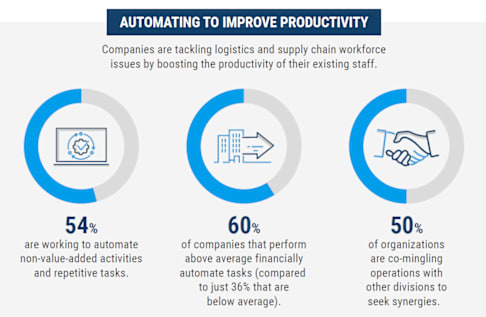
AUTOMATING TO IMPROVE PRODUCTIVITY
Companies are tackling logistics and supply chain workforce issues by boosting the productivity of their existing staff.
are working to automate non-value-added activities
and repetitive tasks.
54% of companies that perform above average financially
automate tasks (compared to just 36% that are
below average).
60% of organizations are co-mingling operations with
other divisions to seek synergies.
50%
European countries highest for automation:
France
62%
Belgium
64%
Netherlands
64%
TECHNOLOGY TO REDUCE THE IMPACT OF LABOR SHORTAGE
Technology may help companies meet logistics and supply chain labor shortage challenges.
of companies are investing in route optimization technology and54% in driver mobile productivity solutions to mitigate the labor workforce shortage.
45%
of German companies deploy delivery route
optimization, the highest of any country surveyed.
63% The UK had the highest number of mobile driver
productivity solutions of any nation surveyed at 49%.
49% of companies have fully
employed full warehouse automation, and a further
26% have partially deployed.
15%
of companies have deployed driverless vehicles in their logistics business, while
14% are partial deployers.
11% of businesses are fully using drones to reduce
workforce requirements, while 13% are partially
leveraging them.
9%
TECHNOLOGY TO REDUCE THE IMPACT OF THE SKILLS SHORTAGE
Technology is helping to address the shortage of skilled and highly talented workers in logistics and supply chain operations.
of organizations cite partially or fully deploying automated real-time shipment tracking to address the supply chain
and logistics knowledge worker shortage.
53% of organizations are
partially or fully deploying AI to reduce workloads.
47% of businesses surveyed in Belgium/Netherlands used real-time tracking, the highest among all surveyed countries.
63%
of Canadian companies use AI for back-office logistics automation.
48% of companies in
Belgium/Netherlands are using advanced analytics to assist backroom operations,
the highest in the sample, compared to only 47% across all countries.
53%
APPROACHES TO ATTRACT NEW WORKERS
of companies offer flexible working hours—the most-cited
perk—to attract Millennial and Gen Z talent.
35% adopt the latest
technology to impress potential younger
talent.
34% of surveyed
organizations offer childcare allowances.
23%
Companies can also boost worker numbers by attracting new talent:
CONCLUSION
The severe workforce shortage in supply chain and logistics is compelling organizations to prioritize productivity and talent acquisition above all else. Automation is a key stop-gap measure to replace labor and knowledge-based tasks while advancing technology is further
improving real-time shopping tracking and route optimization, adding to existing staff’s output per hour worked.
Only
of companies have fully deployed warehouse robots as part of their operations,
with 22% partially deploying them.
12%